Misty Danielle Copeland was born on September 10, 1982, and is an American ballet dancer for American Ballet Theatre (ABT). ABT is one of the top three classical ballet companies in the U.S. Copeland became the first African American woman to be promoted to principal dancer in ABT’s 75-year history on June 30, 2015.
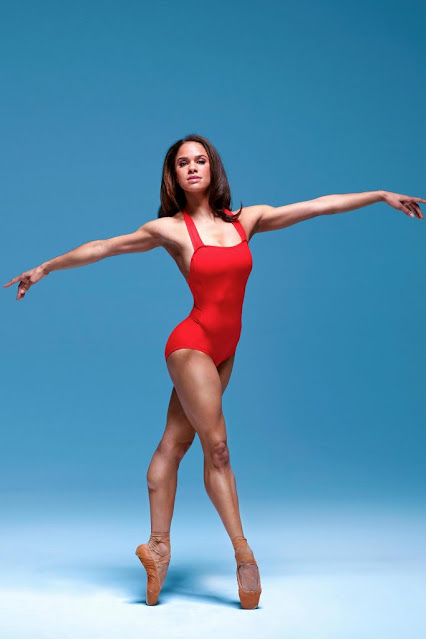
Copeland has established herself as a celebrity spokesperson, a public speaker, and a stage performer in addition to her dance career. Two of her autobiographical books have been published and a documentary about her career challenges has been narrated. The magazine Time named her one of the 100 most influential people in the world in 2015, and she appeared on its cover. She performed in On the Town on Broadway, toured as a featured dancer for Prince, and appeared on the reality television shows A Day in the Life and So You Think You Can Dance. In the past, she has endorsed products and companies such as T-Mobile, Coach, Inc., Dr. Pepper, Seiko, The Dannon Company, and Under Armour.
Throughout this article, we will discuss the workout routine and diet that Misty Danielle Copeland follows daily. Fitness is important to her, so she puts in a lot of effort to stay fit. Therefore, we have compiled a list of her workouts and the kinds of foods she eats. You can learn everything about it here.
Misty Copeland Body Statistics
- Birth Year: 1982
- Birth Date: September 10
- Height: 5′ 2″ (157 cm)
- Weight: 112 pounds (51 kg)
- Breasts: 36 inches
- Waist: 25 inches
- Hips: 36 inches
- Body Measurement: 36-25-36 inches (91-64-91 cm)
Misty Copeland Workout Routine
Misty Copeland Workout Tips and Tricks
Considering that Misty Copeland is quite fit, there is no reason at all not to follow some of her advice! She provides many tips on her social media and during her interviews with many sports and fitness magazines, which inspires people to succeed! Take a look at some of the advice she gives!
Create a goal-oriented vision.
In order to achieve ballerina body goals, Copeland believes the first step is to visualize them in your head. In the morning, she advises you to visualize making your dreams come true – whether that means fitting into an old dress, having the energy to run 10Km, or being able to touch your toes without pain. “Seeing is believing—and achieving,” she says.
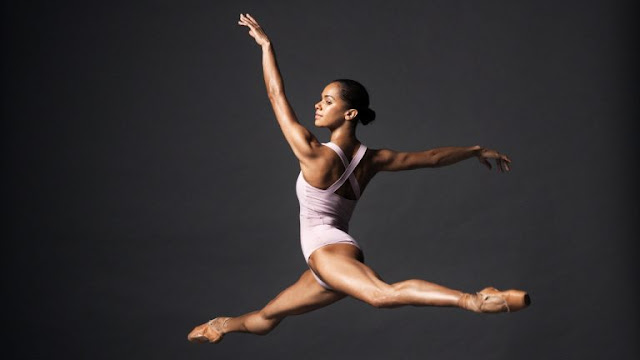
Take a moment to reflect
Copeland makes the case for mental clarity, though it is a buzzword that can sound overblown. Similarly, to a pro athlete who visualizes crossing the finish line, she suggests painting a picture of your ideal ballerina body, finding inspiration to keep your motivation high, and even keeping a journal throughout the process.
A good posture is essential
The reason ballerinas look like goddesses is that they’re trained in the correct posture, which is said to “magnify your presence.” What does this look like? With the back straight, shoulders even, and head looking straight ahead, you should maintain good posture.
There is a key stretch from Copeland that is easy to do anywhere that will help improve posture: “When you find yourself slouching, stand, clasp your hands behind you, and then stretch them down and away from your body.”
Dance on the floor
The ballet dancer kept up her training while undergoing treatment for stress fractures in her tibia by mimicking the warmups students complete at the barre on the floor while lying down. This is a surprisingly challenging routine that, after one session, will leave your hip flexors and calf muscles sore but feeling stronger. Combinations involving plié (bending) are one of the most dramatic segments.
On your back, press your arms against the floor and hold your legs in the first position, making an L-shape by squeezing your body and legs together. Stretch your lower legs back up so that your toes point upwards, then bend your knees until your feet are on the ground. Do this again and again (with a tight core!) and you will see immediate results.
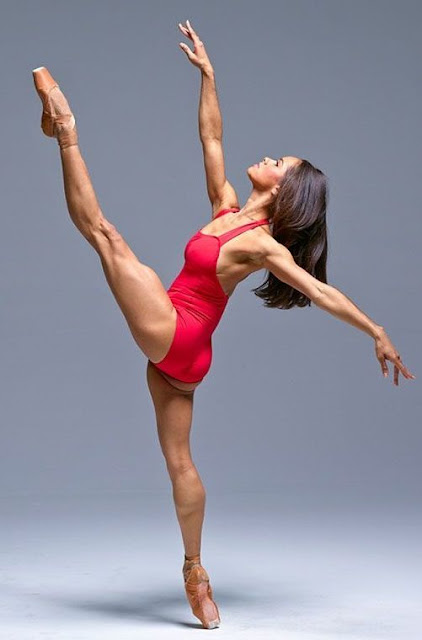
Document your journey.
Copeland believes that getting your ballerina body is all about making smart lifestyle choices and not going on fad diets or exercising like a lunatic to lose weight. During your journey, she recommends writing about how you feel and how you look at the beginning of the journey, how you wish to feel and look in the future, and charting your progress, including your successes and struggles. If you want to go through your thoughts in a more formal way, use a pen that you only use for journal writing, or sit in the same cozy spot when writing.
Meditate for five minutes.
The ideal time to meditate is 15 to 20 minutes. However, a five-minute daily meditation can put you on the right path for the day and reduce your stress level. According to Ballerina Body, Copeland recommends sitting up straight against a wall or in a chair, relaxing your body, and laying back so you can breathe deeply for four full breaths. Then, exhale to the count of five through your mouth. Maintain this breathing pattern for five minutes. Don’t be concerned if you are distracted by your thoughts during this time. Simply try to keep your attention on your breath.
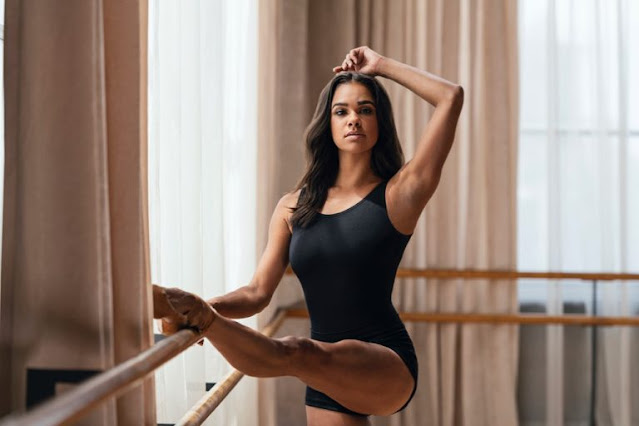
Stretch for good posture.
The ballerina and ballerina body have the hallmark of proper posture. This can give her the appearance that she is confident and strong, but it can also help her breathe efficiently, keeping her calm and centered. Our days are usually spent with our heads hunched over our computers or curled up on our cell phones. Stretches from Ballerina Body are helpful for those with less-than-perfect posture: “Whenever you have a towel or long belt in your hands, hold it so there’s enough space between your hands for you to bring it over your head without bending your elbows. Bring it behind you and back again without bending your elbows or losing the symmetry in your shoulders. Do this two or three times in a row, keeping a slow tempo.”
Release tension in the morning.
Get out of bed as tight as you can before you roll into a ball to get that ballerina body posture. Afterward, release all the tension and breathe. After that, stretch your body like a starfish in every direction you can think of. “Try to imagine opening all of your joints and stretching your muscles,” explains Copeland. Don’t hold any tension in your body. Dancers should resolve their tension every day with this exercise, says Copeland.
Exercise while sitting at your desk.
Exercise is something Copeland advocates no matter where you are with whatever tools you have available to you. Copeland suggests the Torso Turn as a simple ballerina body exercise. Sitting on a chair with your feet parallel to the ground is an easy way to perform this movement. Make sure that you squeeze the hamstrings in the back of your thighs without tightening the buttocks. By turning your upper body right-side-up, placing your right arm over the back of the seat, and gently stretching your upper body toward the floor while keeping your hips forward, gently stretch your upper body toward the floor. Turn your upper body back to the center and repeat on the left side. Perform at least five stretching movements on each side.
Move while lying down.
Getting started with perfecting your form while lying on the floor is an excellent way to learn. The method was also used by Copeland in order to train her ballerina body when she had an injury. You can open your hips through various exercises in the book, but here are a few suggestions:
Lie down on your stomach with your head turned to the right and your arms bent upward at right angles, aligned with your shoulders. You will also need to bend your right knee so that it reaches up toward your right bent elbow as you slowly slide your right foot along the floor. Then, slowly return your right leg to its original position next to your left leg. You can repeat this movement several times.
The third repetition should be done with the front of your foot on the ground. Bend at the knee and point your toe toward the sky. Then pull the knee towards the left leg. Reposition your leg in a straight position next to the left leg. Turn your head and repeat the entire movement with your left leg.
Continue the movements while lying on your back.
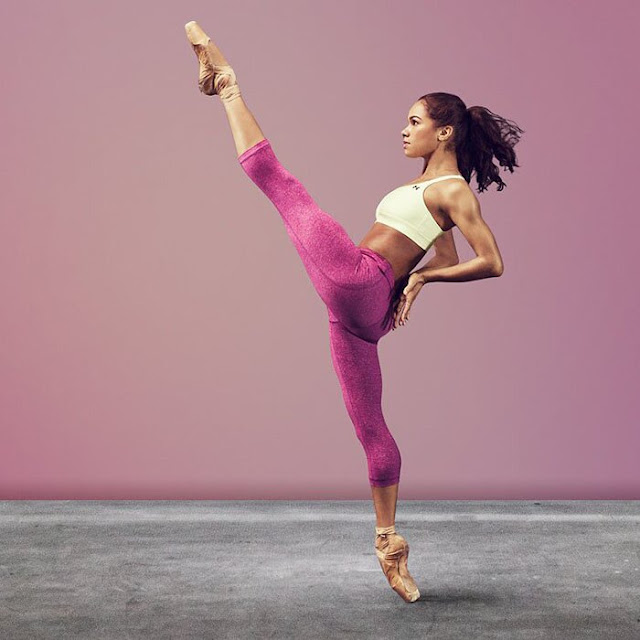
Eat foods rich in healthy fats.
Fish and some nuts are rich in healthy fats, which you can use to burn fat, maintain healthy body weight, and even gain energy (a gram of fat holds twice the amount of energy as a gram of carbs). If you want to maintain a ballerina body, eat foods high in omega-3 fatty acids, such as salmon, tuna, mackerel, halibut, walnuts, and chia seeds.
Season with herbs, not salt.
Upon waking up in the morning, Copeland would complain that she had a blown up stomach and puffy eyes after eating salted and shelled sunflower seeds at night. She believed the seeds were healthy but would wake up with a bloated stomach and puffy eyes. While she uses fresh herbs and garlic for seasoning meals and snacks to maintain her ballerina body, rather than relying on salt, which retains water, so she uses garlic, onions, and fresh herbs instead.
Use olive, coconut, or flaxseed oils.
You should avoid butter, margarine, and canola oil if you want a lean, fit ballerina physique. Instead, consume nutrient-dense oils such as olive oil (which is good for heart health, fights inflammation, and normalizes blood pressure), coconut oil (which is delicious, but has a lot of calories), and flaxseed oil (which helps lower blood pressure and improves blood-brain flow). Despite being not a great cooking option, flax seeds can be used in pesto, hummus, and salad dressings.
Follow Misty’s perfect one-day food plan.
If Copeland wants to keep her energy levels high during her workout sessions, she eats oatmeal for breakfast, a Mediterranean wrap (with mozzarella, Roma tomatoes, arugula, and homemade pesto) for lunch, and coconut quinoa and lentil curry for dinner. Her book, Ballerina Body, contains each of these recipes.
Don’t skip meals.
If fewer meals are eaten, there will be fewer calories consumed each day, right? Skipping meals can actually cause you to miss out on important nutrients in your diet, as well as lead to overeating (ballerina bodies aren’t exactly fragile), due to the fact that you’ll grab whatever is available when you feel starved.
Strive to make healthy choices, even when eating out.
Whenever you are eating out, ask for fish that isn’t breaded, salads, vegetables, quinoa, lentils, or couscous rather than rice, pasta, or potatoes. Although we should not shy away from treating ourselves every now and then, treating ourselves is a part of a healthy eating regime, even for ballerinas.
Make each meal beautiful.
Dining at home should be a fun experience. In the book, Copeland recommends turning each meal into a party. Water should be in a pretty jug, wine should be sipped from a wine glass, good china should be used, and candles should be lit or flowers should be arranged. There is a lot of hard work that goes into the ballerina’s body, but the rewards are also quite handsome.
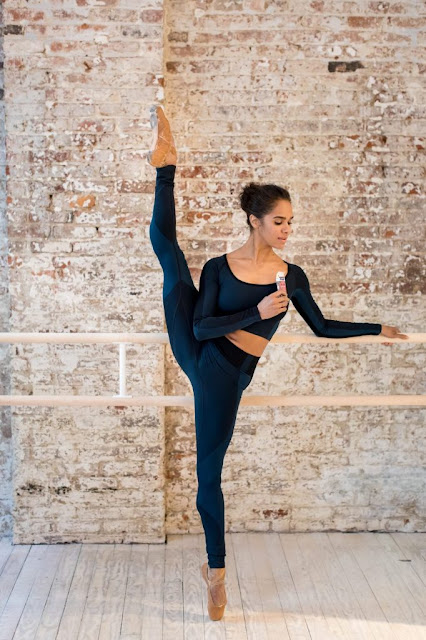
That was all about her workout tips. She also follows a great diet plan which would clearly break the myth that ballerinas do not eat anything and starve themselves. In fact, in the following section, you will see that Misty Copeland follows a strict plan with room for flexibility and wholesome products.
Misty Copeland Diet Plan
As a result of Ballerina Body, her highly-anticipated fitness and nutrition guide, which is out today, the world now knows how she gets her famous physique. A memoir describing Misty’s lifelong journey to gaining confidence in her body and developing sound eating habits-from subsisting on glow-in-the-dark cheese squeezed out of a bottle during childhood, to becoming a ballerina while eating donuts while experiencing body confidence issues, to deciding to give up meat and finally establishing a nutrition protocol that gave her a feeling of fulfillment.
A 21-day meal plan with daily menus and grocery lists is included as well as a wealth of practical tips and recipes. Additionally, Misty offers tips for meditation, visualization, as well as a workout routine that incorporates floor exercises that mimic barre moves, stretching, posture strengthening exercises, and ballet moves.
As a result of reading her book, we broke down her “perfect day” of meals and collected the best tips we have learned:
Breakfast
Muffin or bagel slathered with scallion cream cheese and iced coffee
“I realized dietary discipline doesn’t have to mean deprivation,” it was written by Misty in the introduction. Misty’s book provides a lot of advice on how you should deal with fat. She has a whole chapter devoted to the topic “The Magic of Fat.” “Eating it, absorbing it, and burning it for energy,” she records, “Is the key to building the muscle and providing strength so important for ballerinas.“
In addition to advising the importance of Omega-3 fatty acids (found in fish like tuna), Misty recommends salmon (a pescatarian), which fights inflammation and gives you greater resistance to injury (a nutrient that helps absorb Vitamins A and D).
In addition, she claims dairy offers “a package of essential nutrients, particularly calcium, which dancers need to build bones.” When she broke six legs, Misty claims dairy “was essential” in her diet to recuperate from the injury.
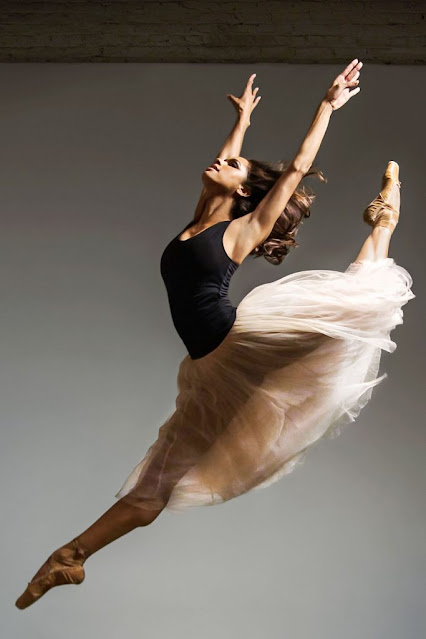
Snack
Cashews and macadamia nuts, with dried pineapple and a few grapes
“Nuts have become my go-to snack. I keep a baggie or a small container of them in my purse and my locker at ABT’s rehearsal studio because I’ve found that they satisfy my hunger and give me a quick spike of energy,” she explains. The amount she suggests is a handful or one-eighth of a cup.
A piece of fresh fruit is another favorite snack of Misty’s-her favorites include grapes, blueberries, and bananas. “At the start of my day, right after ballet class, and before I launch into seven hours of rehearsals, I’ll grab a piece of fruit for an energy boost.”
Two snacks are consumed each day by her. I like three to four pieces of sushi and a serving of cheese.
Lunch
Spinach salad topped with pecans, goat cheese, dried cranberries, light vinaigrette, 2-3 slices of avocado
The “Ballerina Body” book divides Misty’s nutritional philosophy into Act 1 food (primary ingredients and primary fat sources such as animal protein and plant fats) and Act 2 food (vegetables, fruits, starches, grains) you can mix and match. Whenever possible, she suggests always eating one of each at lunch and dinner, making it a rule to load each plate with both protein and carbohydrates.
Meal choreography is her term, and she says, “Like ballet and our workout routine, which take a medley of steps and build from there in combination and complexity, you’ll be able to mix and match a variety of foods to make sure you enjoy what you’re eating and your taste buds don’t get bored.”
Dinner
Grilled salmon, roasted onions, carrots, butternut squash seasoned with rosemary, garlic, salt, and pepper. A glass of prosecco OR a peanut butter cookie.
Dinner should consist of one food from Act 1 and two from Act 2, plus a starch like brown rice or winter squash. The “Act 1” food, according to her, should be grilled, baked, poached, or broiled rather than fried. Since she is a pescatarian, fish usually plays a central role in her dinner. Misty explained that she gave up meat, saying, “I dove in headfirst, becoming a pescatarian overnight. I wouldn’t necessarily recommend going cold turkey as I did. I had dreams of bacon and giant hamburgers for months! But I felt amazing. My energy level skyrocketed.”
If she’s eating out…
Despite her weight, Misty still loves Red Lobster. Yet even when eating at a restaurant, she remains attentive to what she’s consuming. “I like to go with options that don’t have a ton of empty calories added to them. For instance, I’ll order crab legs and a garden salad. Go clean–a piece of fish that isn’t breaded or fried, a salad or vegetable, and quinoa, lentils, or couscous instead of rice,” she explained.
She also emphasizes the importance of eating mindfully, that is, consuming food slowly to facilitate digestion. This“allows you to really relish the flavors you’re tasting, and can help you realize when you’re truly full.”
If she’s traveling…
“I like to take along packaged food that I can rely on to give my body what it needs, especially if I’m heading overseas. I usually carry packets of plain oatmeal, packaged tuna, whole wheat crackers, and nuts.”
Things to avoid…
Last but not least, Sugar, processed food, junk food, fast food, white flour, artificial sweeteners, and soda are among Misty’s forbidden foods. Furthermore, she recommends cutting down on salt and substituting garlic, onions, and herbs instead. Another great tip: don’t eat until you’re overstuffed. “It’s okay to leave food on the plate,” Misty insisted.
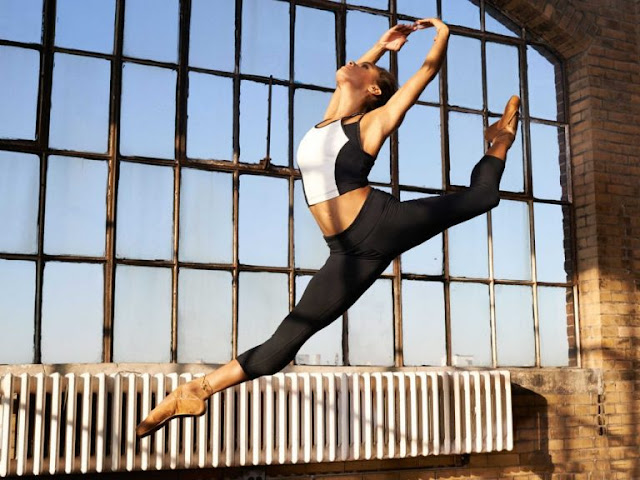
Her belief is that being a top athlete is no easy task, and diet plays a key role in it. Considering everything she eats on a daily basis is important to her. As such, she has to fill her body with the right foods, which act as fuel for it, and not eat empty calories that taste good but do not have any nutritional value. Her most important diet secret is eating clean and staying lean. Meats such as chicken, pork, and red meat have been eliminated from her diet. Misty eats fish regularly. She is a pescatarian. There are even days when she becomes vegetarian.
It is one of the secrets of her diet that she consumes whatever she enjoys while controlling portions. It is Misty’s policy to stop eating when she is full and to stop forcing herself to eat when not hungry. We hope you will try them too. (These ideas are very simple to follow.)
It’s important for this ballerina to listen to what their bodies need. Her body gets the nutrients it needs when it requires protein, and when it needs water, she drinks plenty of it. A good diet is one in which the body is listened to and responded to accordingly.
Misty Copeland is a principal dancer at the American Ballet Theatre. She spends eight hours a day in the studio training, rehearsing, and preparing for performances. When she walks between studios, her longest break often happens during the five minutes between. This does not imply, though, that she doesn’t find time for cooking.
“I am happiest when I’m on stage or in the kitchen,” she explains to Food & Wine.
As an athlete known for her lean, muscular body, Copeland treats her body like a machine by maintaining proper posture. For example, she roasts Brussels sprouts and carrots, transforms cauliflower into mashed potatoes, sautés kale with garlic, charbroiled salmon (she is a pescatarian), and bakes tilapia.
“I learned [how to cook] from watching the Food Network. Rachel Ray’s 30 Minute Meals was one of the first cookbooks that I bought,” she explains.
Although Copeland is well aware of the negative stereotypes associated with dancers and their food choices, he aims to set an example by leading by example.
“There is this stigma attached to being a ballet dancer that we don’t eat and that we aren’t athletes,” she claims.
It has everything to do with balance, however, as Copeland shows. The woman eats a lot of vegetables, as well as making her own pizza at home, enjoying the occasional glass of wine, tuna melt for lunch, and cookies and cake for dessert. In terms of changing the way the public views her profession, she has more than earned the credit she is being given.
“Showing me behind the scenes, in the studio, and showing my muscles,” she adds, “is really changing the way Americans view dancers.”
Although finding the right diet and becoming comfortable in her body did not happen overnight. Time, patience, and, in the case of her diet, trials, and errors led her to achieve what she had set out to do.
“It took me so many years to learn what works for my body,” she recalls.
During her childhood, Copeland said she ate sunflower seeds like a bird, continually snacking on them. When she was growing up, Copeland’s family struggled financially, so “nutrition was not something I was knowledgeable about.” Once she became a professional dancer, Copeland had to transform the diet she ate to maintain stamina, strength, and energy into a version of what she ate when she was a teenager.
At present, Copeland brings grapes, cherries, and dried fruits like apricots into the studio during performance periods, mixed together with nuts like peanuts, pistachios, and almonds. Besides partnering with Naked Juice, she often eats their Naked Fruit, Nut & Veggie Bars throughout the day, which she often shares with her fans.
However, snacks alone won’t sustain her for long. As a result, she prefers to eat yogurt and oatmeal in the morning, and dinner is her largest meal of the day because she avoids performing with an empty stomach. The ballet routine requires lifts, leaps, and turns often high into the air, a routine that is different from that of most other sports. So dancers typically “fuel” the night before their performances. It is important for them to eat properly on the day of the performance so that they maintain their energy levels.“Our aesthetic is so much a part of what we do,” shares Copeland. “We have to physically get through a three-hour performance, but also our bodies are our instrument. That differs from the football players, who would eat steak or pasta before a performance.”
Ballet dancer Copeland emphasizes that she has tailored her diet over the years to match what makes her feel best and encourages other ballet dancers to eat what makes them feel strong, healthy, and satisfied. While it takes effort, the results are worth it.
“This isn’t some easy thing that I have stepped into,” she acknowledges. “Figuring out what food works for my body—it’s not a quick diet or a fad. You have to make the decision to approach your life in a healthy way.”
The dancer advises her fellow dancers to take advantage of the structure and discipline already in their schedules. This can be applied to their diets as well, ensuring they eat regularly throughout the day and find meals they enjoy. Do you have any words of advice for people who want to pursue the profession? “Respect your body for what it is.”
She’s a Pescetarian
In contrast to most pescetarians, Copeland doesn’t eat meat, poultry, or eggs. Instead, he eats different kinds of seafood, including fish, shrimp, and clams, as well as dairy products and plants. As a vegetarian, she receives all the nutritional benefits of a vegetarian diet, plus, she also supplements her diet with fish to get high-quality protein, omega-3s, and other nutrients.
Throughout her book Ballet Body, released last year, Copeland stressed the importance of fats like omega-3s that can be found in tuna, sardines, or salmon, her favorite.
“Eating it, absorbing it, and burning it for energy is the key to building the muscle and providing strength so important for ballerinas,” she claims.
Furthermore, other health benefits of a pescatarian diet include reduced risk of heart disease, type 2 diabetes, dementia, and depression.
That was all about her diet plan, which provides her with the necessary strength necessary for a person of her age and fitness level. She also gives out some great diet tips about what we can learn in the following sections.
Misty Copeland Diet Tips
In this section, she gives out some tips to people who she thinks might want to follow in her footsteps and get inspired by a similar kind of diet plan. So take a good read ahead and see for yourself how does she manage to stay on track every single day!
Snack Smart
Misty Copeland Nutrition and Supplements
Among the first African-American women to reach principal status at the American Ballet Theatre, she takes calcium supplements, since calcium is essential for dancing. Dancers put excess stress on their bones while jumping, which results in a higher risk of fractures for beautiful dancers. Several years ago, she had been severely injured in her tibia. Besides calcium supplements, she also takes Vitamin D supplements.
0 Comments:
Post a Comment